7 Effective Steps to Master ACT Practice Questions for Reading
· based on the channel PrepSolution
ACT Reading practice questions test your ability to understand and analyze passages efficiently and accurately. To excel, focus on 7 targeted steps that guide you through different question types, help you find evidence, and avoid common traps. These strategies apply to all ACT Reading sections, including literary narratives and informational essays.
1 Understand the Four Main Question Types in ACT Reading Practice Questions
ACT Reading questions primarily fall into four categories: main idea and purpose, details and sequence, inference and evidence, and words and phrases in context. Recognizing the question type first helps you know where to look in the passage and what kind of answer to expect.
- Main Idea and Purpose: Identify the overall function of the passage without confusing minor details for the central point.
- Details and Sequence: Locate specific lines or events and understand their correct order as presented.
- Inference and Evidence: Make only those inferences directly supported by the text, and match them with precise evidence.
- Words and Phrases in Context: Use the surrounding sentence to deduce the meaning of unfamiliar words or phrases.
2 Map Each Passage Before Answering Questions
Before jumping into the questions, quickly map out the passage by noting the main idea of each paragraph or section. This mental outline helps you locate information faster and avoid rereading large chunks. For instance, when a question asks about a specific detail or sequence, you’ll know exactly where to find it.
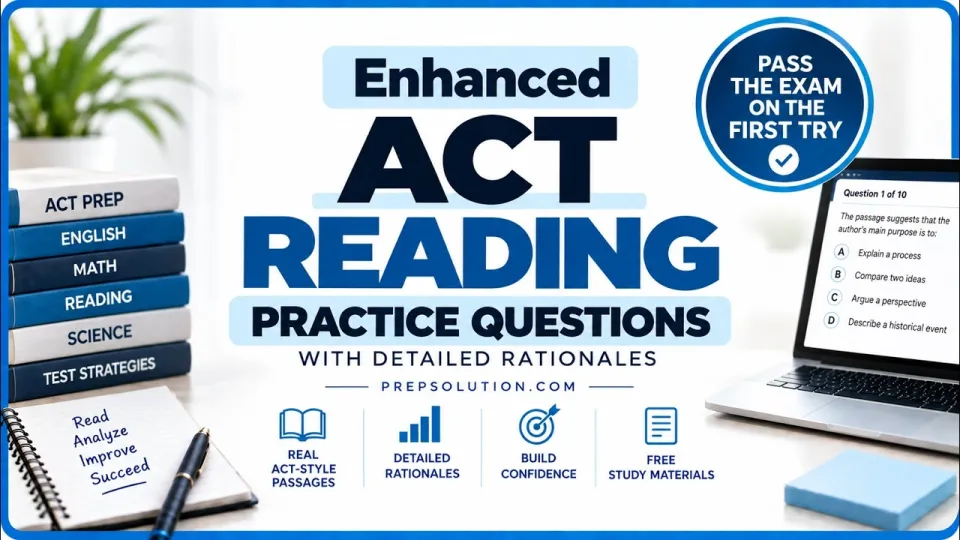
Video: ACT Reading Practice Questions | Detailed Rationales with Tips & Tricks
3 Use Textual Evidence to Check Every Answer
Always verify your answer by referring back to the passage. The ACT expects answers grounded in the text. Avoid answers that rely on outside knowledge or assumptions beyond what the passage states. When stuck between two answers that seem correct, return to the exact lines cited by the question to see which is best supported.
4 Practice Ruling Out Distractors and Trap Answers
Many ACT Reading questions include tempting distractors—answers that sound plausible but are incorrect. Common traps include:
- Answer choices that are true but irrelevant.
- Extreme or overly broad statements not supported by the passage.
- Misinterpretations of the author’s tone or purpose.
Train yourself to recognize these by cross-checking each choice against the passage’s words and meaning.
5 Develop Strategies for Specific Question Types
Each question type requires a slightly different approach:
- Main Idea Questions: Focus on the passage’s introduction and conclusion; these often reveal the author’s main message.
- Detail Questions: Find and reread the exact sentence or paragraph referenced.
- Inference Questions: Limit your inference strictly to what is implied in the text, not what you speculate.
- Vocabulary in Context: Cover the word, read the surrounding sentence, and use clues like synonyms or contrasts.
- Point of View Questions: Identify who is narrating and their attitude by noting pronouns and descriptive language.
6 Practice with Both Literary and Informational Passages
ACT Reading includes diverse passage types. Practice with both literary narratives (stories, dialogues) and informational essays (scientific, historical, social topics). This variety sharpens your ability to adjust reading speed and critical thinking based on passage style and content.
7 Review and Score Your Practice Sessions
Keep track of your answers and score yourself out of 10 questions per practice set. After completing a set, review every wrong answer carefully using detailed explanations and rationales. Learn from mistakes and note which passage type or question category challenges you most to focus your next practice.
Helpful Links
- PrepSolution ACT Complete Prep System — comprehensive ACT prep with practice questions and strategies.
Conclusion
Mastering ACT practice questions for reading requires understanding the question types, mapping passages, and carefully checking answers against the text. Using strategies to rule out distractors and practicing with varied passages will boost comprehension and accuracy. The channel PrepSolution offers detailed rationales and practical tips that can enhance your ACT Reading preparation. For continued improvement, explore their full prep system linked above and keep practicing consistently.
Key takeaways
- ACT Reading includes 4 main question types: main idea, details, inference, and vocabulary.
- Effective ACT Reading strategies involve mapping passages and using text evidence.
- Ruling out wrong answers is key to improving accuracy on ACT Reading questions.
- Practice with both literary narratives and informational essays enhances comprehension.
- PrepSolution offers detailed rationales and practical tips for ACT Reading practice.
Source: ACT Reading Practice Questions | Detailed Rationales with Tips & Tricks · Markdown version
Questions & answers
What types of questions are most common in ACT Reading practice?
The most common ACT Reading question types are main idea and purpose, details and sequence, inference and evidence, and understanding words and phrases in context.
How can I improve accuracy when answering ACT Reading questions?
Improve accuracy by mapping passages before answering, verifying each answer with exact text evidence, and ruling out distractors that are plausible but unsupported by the passage.
Is it important to practice both literary and informational passages?
Yes, practicing both literary narratives and informational essays helps you adapt your reading strategies to different styles and content, which is essential for the ACT Reading section.
Where can I find detailed explanations and strategies for ACT Reading?
The PrepSolution channel provides detailed rationales, tips, and strategies for ACT Reading practice questions, and their ACT Complete Prep System offers comprehensive resources.